
Dr Ahsan Tariq , MBBS, MRCP (UK ) ongoing, IMT ( Internal Medicine Trainee, NHS England), GMC : 7805049
Dr Ahsan Tariq is a UK-registered medical doctor with a background in internal medicine and a focus on evidence-based research in cognitive health and nootropics. He critically reviews scientific studies, supplements, and ingredients to help readers make informed, safe, and effective choices for brain health and performance.
Introduction: What Is Self Awareness
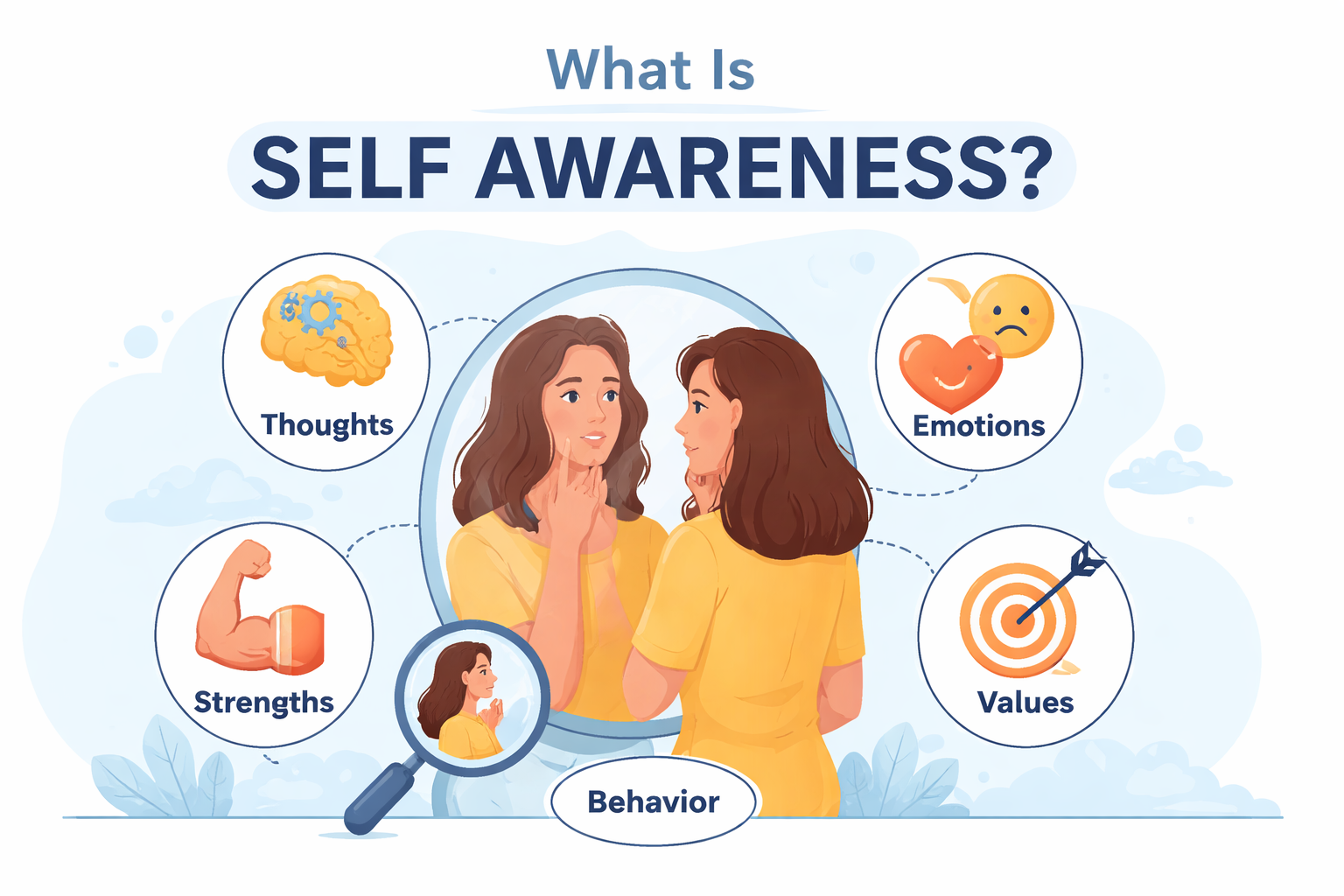
Self awareness is one of the most discussed yet often misunderstood concepts in psychology and personal development. Many people associate it with simply knowing their emotions, but scientifically, self awareness goes far deeper. It involves understanding your thoughts, emotions, behaviors, motivations, strengths, and limitations, and how these internal factors influence your interactions with the world.
In modern psychology, self awareness is considered a foundational skill for emotional intelligence, mental well-being, leadership effectiveness, and healthy relationships. Research shows that individuals with higher self awareness tend to make better decisions, manage stress more effectively, and maintain stronger social connections [1]. This article provides a comprehensive, science-based explanation of what self awareness is, how it works, its benefits and risks, and how to develop it safely and effectively.
Understanding The Topic
What Is Self Awareness
Self awareness is the ability to consciously recognize and understand one’s own internal states, traits, behaviors, and their impact on others. According to early psychological theory, self awareness involves the self becoming the object of attention [2]. This means you are not only experiencing thoughts and emotions but also observing and evaluating them.
Psychologists commonly divide self awareness into two types: internal self awareness and external self awareness. Internal self awareness focuses on understanding your own values, emotions, goals, and reactions, while external self awareness refers to understanding how others perceive you [3]. Both forms are essential for balanced personal and social functioning.
Core Components Of Self Awareness
Self awareness is not a single skill but a combination of interconnected cognitive and emotional processes. These include emotional recognition, self-reflection, metacognition, and perspective-taking [4]. Together, these components allow individuals to monitor their behavior, adjust responses, and align actions with personal values.
How It Works
Psychological Mechanisms Behind Self Awareness
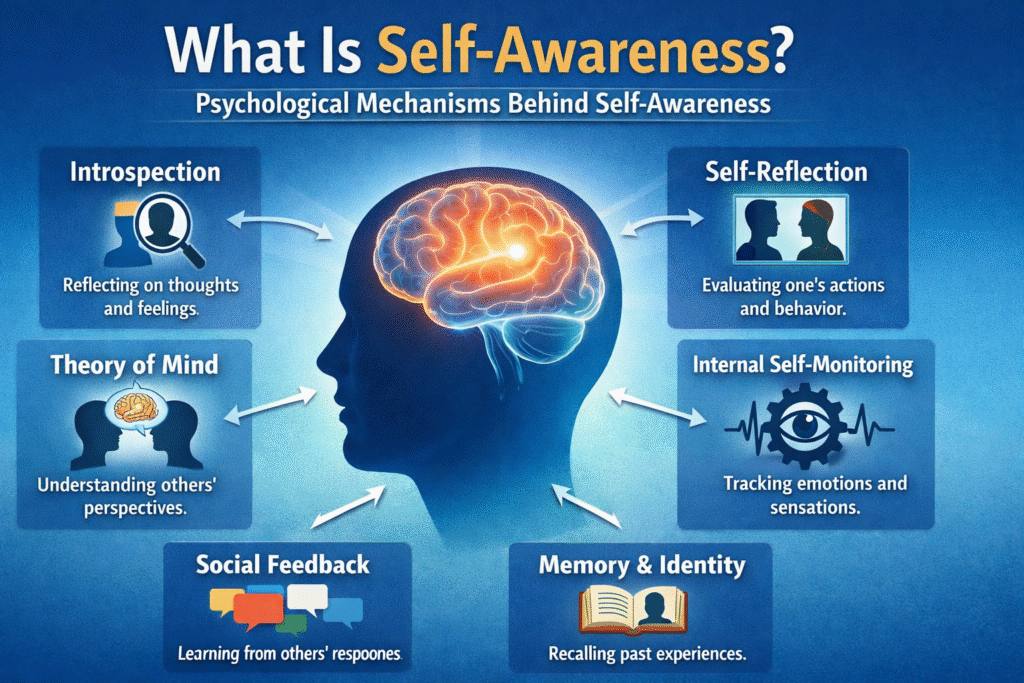
Self awareness operates through attentional and cognitive control systems in the brain. When attention is directed inward, individuals engage in self-evaluation processes that compare current behavior with internal standards or goals [5]. This comparison mechanism helps regulate behavior and emotional responses.
Neuroscientific research suggests that areas such as the prefrontal cortex and anterior cingulate cortex play a key role in self monitoring and reflection [6]. These regions support error detection, emotional regulation, and conscious awareness of internal states.
Development Across The Lifespan
Self awareness develops gradually from childhood into adulthood. Early forms appear in infancy, such as recognizing oneself in a mirror, while more complex reflective abilities emerge during adolescence as cognitive capacities mature [7]. Environmental feedback, parenting styles, and social interactions significantly shape this development [8].
Importance Of Self Awareness
Role In Mental Health
Self awareness is strongly linked to psychological well-being. Individuals who can accurately identify and understand their emotions are better equipped to manage anxiety, depression, and stress-related disorders [9]. Therapeutic approaches such as cognitive behavioral therapy heavily rely on enhancing self awareness to change maladaptive thought patterns [10].
Impact On Relationships And Work
In social and professional contexts, self awareness improves communication, empathy, and conflict resolution. Studies show that leaders with high self awareness are perceived as more effective and trustworthy by their teams [11]. Understanding one’s strengths and weaknesses also supports career development and job satisfaction [12].
Proven Benefits Of Self Awareness
Emotional Regulation And Resilience
Self awareness enables individuals to recognize emotional triggers and respond thoughtfully rather than react impulsively. This skill is associated with higher emotional resilience and lower emotional burnout [13].
Better Decision Making
When individuals understand their biases, motivations, and emotional states, they make more rational and value-consistent decisions. Research indicates that self reflective practices improve judgment accuracy and ethical decision making [14].
Improved Learning And Growth
Self awareness supports continuous personal growth by allowing individuals to assess performance accurately and seek appropriate feedback. Educational research links self awareness with higher academic achievement and motivation [15].
Potential Risks Of Self Awareness
Excessive Self Focus
While self awareness is beneficial, excessive inward focus can lead to rumination and increased anxiety. Studies show that maladaptive self focus is associated with depressive symptoms and reduced well-being [16].
Self Criticism And Reduced Confidence
If self awareness is not balanced with self compassion, individuals may become overly critical of themselves. This can negatively impact self esteem and performance [17].
Scientific Evidence
Key Research Findings
Empirical studies consistently support the role of self awareness in emotional intelligence and psychological adjustment [18]. Longitudinal research shows that individuals who score higher on self awareness measures demonstrate better coping strategies over time [19].
Measurement Of Self Awareness
Psychologists measure self awareness using self report scales, behavioral observations, and feedback-based assessments. Tools such as the Self Consciousness Scale have been widely validated in research settings [20].
Benefits Vs Risks Comparison
Comparison Table
| Aspect | Benefits | Risks |
|---|---|---|
| Emotional processing | Better regulation and clarity | Rumination if excessive |
| Decision making | Improved judgment | Overthinking |
| Personal growth | Increased insight | Self criticism |
Safe Usage Guidelines
How To Practice Self Awareness Healthily
Healthy self awareness involves balanced reflection without judgment. Mindfulness-based practices emphasize observing thoughts and emotions without attachment, which reduces the risk of rumination [21].
Role Of Feedback And Support
External feedback from trusted individuals helps maintain accurate self perception. Research shows that combining self reflection with external input leads to more accurate self assessments [22].
Who Should Avoid It
Situations Requiring Caution
Individuals experiencing severe anxiety or depressive disorders may find intense self focus distressing. In such cases, self awareness practices should be guided by mental health professionals [23].
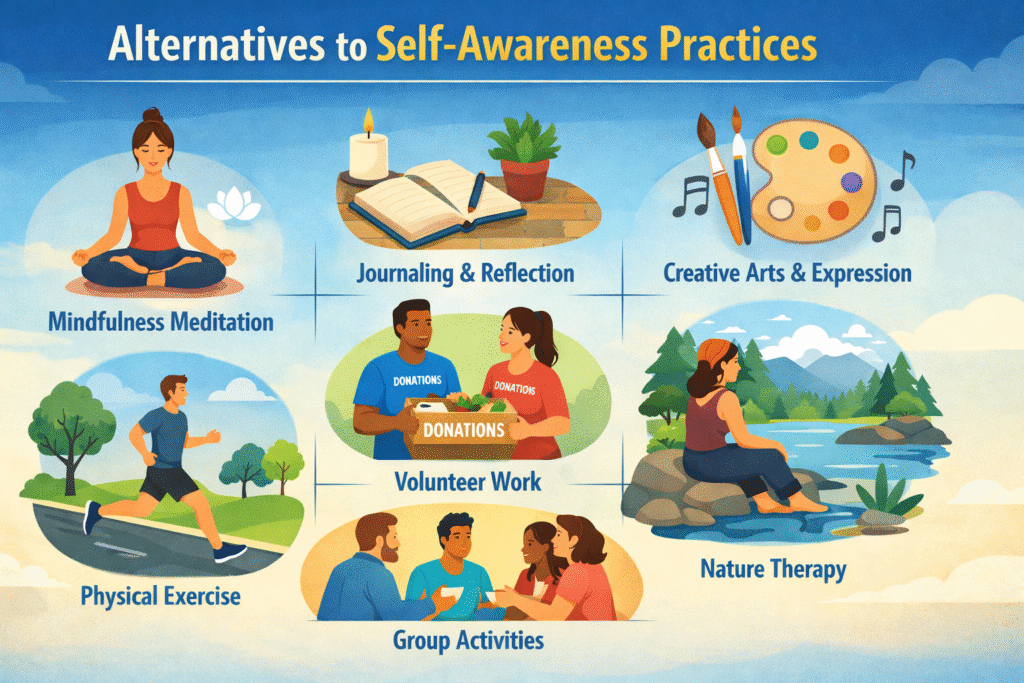
Alternatives To Self Awareness Practices
Behavioral Focused Approaches
Behavioral activation and skills-based interventions focus on action rather than introspection and can be effective alternatives for some individuals [24].
Values And Goal Oriented Methods
Focusing on values clarification and goal setting can promote growth without excessive self analysis [25].
Expert Opinions
Views From Psychology Experts
Experts emphasize that self awareness should be paired with self acceptance. According to contemporary psychological models, awareness without compassion can be counterproductive [26].
Key Takeaways
Self awareness is a foundational psychological skill that supports emotional regulation, decision making, and personal growth. When practiced in a balanced and informed manner, it offers significant benefits while minimizing potential risks.
FAQs
Is Self Awareness A Skill Or A Trait
Research suggests it is a skill that can be developed through practice and feedback [27].
Can Self Awareness Be Learned
Yes, interventions such as mindfulness training and therapy have been shown to enhance self awareness [28].
Is Too Much Self Awareness Harmful
Excessive self focus without balance can increase stress, highlighting the need for moderation [29].
Conclusion
Self awareness is more than simply understanding emotions; it is a complex, scientifically grounded process that shapes mental health, relationships, and performance. By developing self awareness responsibly and with evidence-based strategies, individuals can enhance well-being while avoiding common pitfalls.
References
[1] Duval, S., & Wicklund, R. A. (1972).
[2] James, W. (1890).
[3] Sutton, A., Williams, H., & Allinson, C. (2015).
[4] Morin, A. (2011).
[5] Carver, C. S., & Scheier, M. F. (1981).
[6] Fleming, S. M., et al. (2012).
[7] Rochat, P. (2003).
[8] Eisenberg, N. (2000).
[9] Gross, J. J. (2015).
[10] Beck, A. T. (1976).
[11] Eurich, T. (2018).
[12] Judge, T. A. (2001).
[13] Tugade, M. M., & Fredrickson, B. L. (2004).
[14] Kahneman, D. (2011).
[15] Zimmerman, B. J. (2002).
[16] Nolen-Hoeksema, S. (2000).
[17] Neff, K. D. (2003).
[18] Goleman, D. (1995).
[19] Roberts, B. W. (2006).
[20] Fenigstein, A. (1975).
[21] Kabat-Zinn, J. (1994).
[22] Atwater, L. E. (1998).
[23] American Psychological Association. (2013).
[24] Martell, C. R. (2001).
[25] Locke, E. A., & Latham, G. P. (2002).
[26] Rogers, C. (1961).
[27] Grant, A. M. (2001).
[28] Shapiro, S. L. (2006).
[29] Trapnell, P. D., & Campbell, J. D. (1999).
[30] Brown, K. W., & Ryan, R. M. (2003).