
Dr Ahsan Tariq , MBBS, MRCP (UK ) ongoing, IMT ( Internal Medicine Trainee, NHS England), GMC : 7805049
Dr Ahsan Tariq is a UK-registered medical doctor with a background in internal medicine and a focus on evidence-based research in cognitive health and nootropics. He critically reviews scientific studies, supplements, and ingredients to help readers make informed, safe, and effective choices for brain health and performance.
Introduction
A stretching routine for beginners is one of the most important yet misunderstood components of physical fitness. Many beginners either skip stretching entirely or perform it incorrectly, assuming it is optional or only useful for athletes. Scientific research clearly shows that regular stretching plays a vital role in maintaining muscle health, joint mobility, posture, and long-term physical function [1].
In modern lifestyles, prolonged sitting, screen time, and reduced physical activity have led to widespread muscle stiffness, reduced flexibility, and postural imbalances [2]. Beginners often experience tight hamstrings, stiff hips, neck tension, shoulder discomfort, and lower back pain. These issues do not usually appear overnight but develop gradually due to limited movement and poor flexibility habits.
A structured stretching routine for beginners is designed to safely reintroduce movement to the body. It focuses on controlled muscle lengthening, breathing awareness, and gradual adaptation. Unlike advanced flexibility programs, beginner routines prioritize safety, consistency, and proper technique rather than extreme range of motion.
This article provides a complete, evidence-based guide to stretching for beginners. It explains how stretching works, why it matters, its proven benefits and risks, scientific evidence, expert opinions, safe usage guidelines, and practical alternatives, all supported by authoritative references.
Understanding The Topic
What Is A Stretching Routine For Beginners
A stretching routine for beginners is a planned sequence of gentle movements that aim to improve flexibility, mobility, and muscle awareness without placing excessive stress on joints or soft tissues. It is specifically designed for individuals with limited flexibility, sedentary habits, or no prior experience with structured exercise [3].
Unlike general stretching advice, beginner routines follow a progressive approach. This means starting with simple movements, holding stretches for shorter durations, and focusing on major muscle groups that commonly become tight due to daily activities. The goal is not to force muscles to stretch but to allow the nervous system and muscles to adapt gradually [4].
Common Beginner Misconceptions
Many beginners believe stretching should be painful to be effective. Research contradicts this belief, showing that pain during stretching increases injury risk and reduces long-term adherence [5]. Another misconception is that stretching alone can prevent all injuries. While stretching improves movement quality, it works best as part of a balanced fitness routine that includes strength and mobility training [6].
How It Works
Physiological Response To Stretching
Stretching affects both the muscular and nervous systems. When a muscle is stretched, specialized sensory receptors known as muscle spindles detect changes in muscle length and speed, while Golgi tendon organs monitor tension [7]. These receptors regulate how muscles respond to stretching and help prevent overstretching injuries.
Over time, consistent stretching improves stretch tolerance. Studies show that flexibility gains in beginners are largely due to neural adaptations rather than permanent structural changes in muscle fibers [8]. This means the brain becomes more comfortable allowing the muscle to move through a greater range of motion.
Short-Term And Long-Term Adaptations
In the short term, stretching increases blood flow, reduces muscle stiffness, and temporarily improves joint range of motion [9]. Long-term stretching programs lead to improved movement efficiency, reduced musculoskeletal discomfort, and better posture, especially in sedentary individuals [10].
Importance
Importance For Beginners And Sedentary Individuals
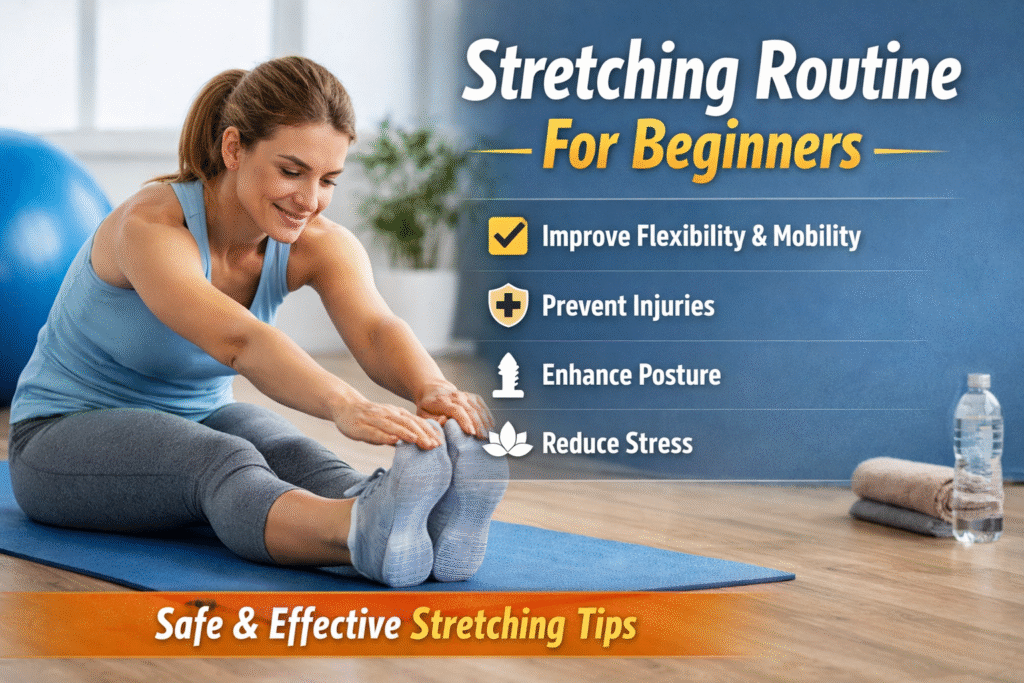
For beginners, stretching is essential because it prepares the body for movement. Tight muscles restrict joint motion, forcing other muscles or joints to compensate, which increases the risk of pain and injury [11]. Stretching helps restore natural movement patterns and reduces unnecessary strain.
Importance For Posture And Daily Function
Poor posture is strongly linked to muscle tightness and imbalance. Tight hip flexors, hamstrings, chest muscles, and neck muscles contribute to forward head posture, rounded shoulders, and lower back discomfort [12]. A consistent stretching routine helps correct these imbalances and supports spinal alignment.
Proven Benefits
Improved Flexibility And Range Of Motion
Scientific studies consistently show that regular stretching improves flexibility and joint range of motion, even in individuals with long-term sedentary habits [13]. Improved flexibility allows joints to move more freely and reduces movement restrictions during daily activities.
Reduced Muscle Stiffness And Discomfort
Stretching increases circulation to muscles and connective tissues, helping reduce stiffness caused by prolonged sitting or repetitive tasks [14]. This is particularly beneficial for office workers and beginners starting physical activity after long periods of inactivity.
Enhanced Physical Performance
While stretching is not a strength-building activity, improved flexibility supports better movement mechanics, balance, and coordination [15]. This indirectly enhances performance in walking, lifting, and exercise activities.
Stress Reduction And Mental Wellbeing
Stretching combined with slow, controlled breathing activates the parasympathetic nervous system, promoting relaxation and reducing stress levels [16]. Many beginners report improved body awareness and reduced tension after regular stretching sessions.
Potential Risks
Overstretching And Muscle Strain
One of the most common risks for beginners is overstretching. Stretching beyond a comfortable range can cause muscle strains, ligament stress, or tendon irritation [17]. This often occurs when beginners imitate advanced flexibility routines without proper preparation.
Reduced Strength Output
Research shows that prolonged static stretching immediately before strength or power activities may temporarily reduce muscle force production [18]. For beginners, this risk can be minimized by performing static stretching after exercise rather than before intense activity.
Risks For Certain Health Conditions
Individuals with joint hypermobility, arthritis, or previous injuries may experience joint instability or pain if stretching is not modified appropriately [19]. In such cases, professional guidance is recommended.
Scientific Evidence
Evidence Supporting Stretching For Flexibility
A large body of research confirms that stretching programs lasting several weeks significantly improve flexibility and movement quality in adults [20]. These improvements are observed across different age groups and activity levels.
Stretching And Injury Prevention Research
While stretching alone does not completely prevent injuries, studies show that improved flexibility and mobility reduce movement limitations that contribute to muscle strains and overuse injuries [21].
Long-Term Health Impact
Long-term stretching interventions have been associated with reduced musculoskeletal discomfort, improved posture, and enhanced quality of life in sedentary populations [22].
Benefits Vs Risks Comparison
| Aspect | Benefits | Risks |
|---|---|---|
| Muscle Health | Increased flexibility and circulation | Strains from overstretching |
| Joint Function | Improved range of motion | Instability if technique is poor |
| Injury Risk | Reduced movement restrictions | Increased risk if pain is ignored |
| Mental Health | Stress reduction and relaxation | Minimal when done correctly |
Safe Usage Guidelines
Frequency And Duration
Beginners should aim to stretch at least three to five times per week. Each stretch should be held for 15 to 30 seconds and repeated two to three times per muscle group [23].
Warm-Up Considerations
Stretching warm muscles is safer and more effective. Light activity such as walking or gentle movement before stretching reduces injury risk [24].
Proper Breathing Techniques
Slow, deep breathing helps muscles relax and improves stretch effectiveness. Holding breath during stretching increases muscle tension and should be avoided [25].
Pain And Body Awareness
Stretching should never cause sharp or intense pain. Mild tension is acceptable, but pain is a clear signal to stop or reduce intensity [26].
Who Should Avoid It
Acute Injuries And Medical Conditions
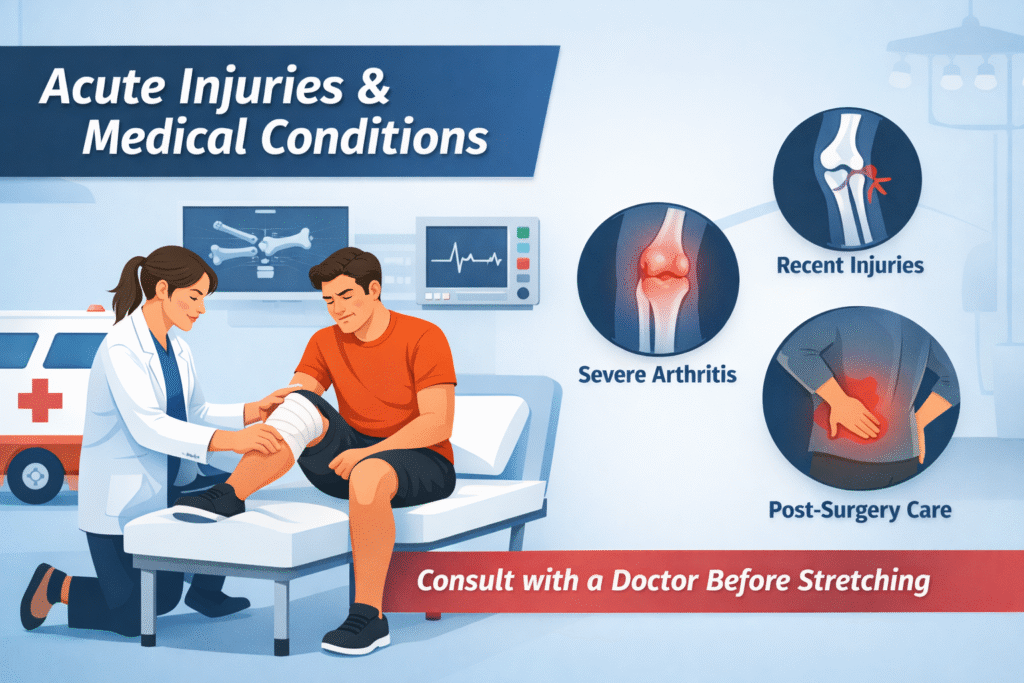
Individuals with recent muscle tears, fractures, or surgical procedures should avoid stretching until cleared by a healthcare professional [27].
Severe Joint Disorders
People with advanced arthritis or joint instability should follow medically supervised stretching programs to avoid worsening symptoms [28].
Alternatives
Mobility Training
Mobility exercises combine strength and flexibility, improving joint control through full ranges of motion and supporting long-term movement health [29].
Yoga And Pilates
Yoga and Pilates integrate stretching with balance, breathing, and strength, making them suitable structured alternatives for beginners when properly modified [1].
Foam Rolling And Self-Release
Self-myofascial release techniques such as foam rolling help reduce muscle tension and improve circulation when used alongside stretching [2].
Expert Opinions
Physical Therapy Perspective
Physical therapists emphasize that stretching should be individualized and progressive. Consistency and proper technique are more important than intensity [3].
Sports Science Perspective
Sports scientists highlight that stretching improves movement efficiency and supports injury prevention when combined with strength training [4].
Key Takeaways
Stretching routines for beginners are essential for improving flexibility, posture, and daily movement. Safe, consistent practice leads to better physical function and reduced discomfort over time.
FAQs
How Long Should Beginners Stretch
Most beginners benefit from 10 to 20 minutes of stretching per session, depending on individual flexibility and comfort levels [5].
Is Stretching Better Before Or After Exercise
Dynamic stretching is recommended before exercise, while static stretching is more effective after physical activity [6].
Can Stretching Help With Back Pain
Gentle stretching can help relieve muscular back discomfort, but it should not replace medical treatment for chronic pain conditions [7].
Conclusion
A stretching routine for beginners is a scientifically supported and accessible way to improve physical health, movement quality, and overall well-being. When performed correctly, stretching enhances flexibility, posture, stress management, and functional movement. Beginners should focus on gradual progress, proper technique, and consistency rather than intensity. By adopting evidence-based stretching habits, individuals can build a strong foundation for lifelong movement health.
References
- American College of Sports Medicine, 2018
- World Health Organization, 2020
- Mayo Clinic, 2019
- National Academy of Sports Medicine, 2021
- Behm DG et al., 2016
- Chaouachi A et al., 2010
- Sharman MJ et al., 2006
- Weppler CH, Magnusson SP, 2010
- Magnusson SP, 1998
- Konrad A et al., 2020
- Kendall FP et al., 2005
- Page P, 2012
- Decoster LC et al., 2005
- Herbert RD, Gabriel M, 2002
- McHugh MP, 2014
- Benson H, Proctor W, 2010
- Thacker SB et al., 2004
- Simic L et al., 2013
- Russek LN, 2000
- Behm DG, Chaouachi A, 2011
- Lauersen JB et al., 2014
- Hunter DJ, Bierma-Zeinstra S, 2019
- ACSM Position Stand, 2011
- Shellock FG, Prentice WE, 1985
- Jerath R et al., 2006
- American Physical Therapy Association, 2020
- Brukner P, Khan K, 2017
- Hunter DJ et al., 2019
- Cook G, 2014
- World Confederation for Physical Therapy, 2021