
Dr Ahsan Tariq , MBBS, MRCP (UK ) ongoing, IMT ( Internal Medicine Trainee, NHS England), GMC : 7805049
Dr Ahsan Tariq is a UK-registered medical doctor with a background in internal medicine and a focus on evidence-based research in cognitive health and nootropics. He critically reviews scientific studies, supplements, and ingredients to help readers make informed, safe, and effective choices for brain health and performance.
Introduction
Bicep workouts are among the most popular strength training routines worldwide, valued for both aesthetic appeal and functional strength. Strong biceps support daily activities such as lifting, pulling, and carrying while also contributing to balanced upper-body development. Despite their popularity, many people perform bicep workouts incorrectly, leading to limited results or avoidable injuries. Understanding how bicep workouts work, their benefits, risks, and scientifically supported training principles is essential for safe and effective progress.
Understanding The Topic
What Are Bicep Workouts
Bicep workouts are resistance exercises designed to strengthen and develop the biceps brachii muscle, located on the front of the upper arm. These workouts typically involve elbow flexion movements using body weight, free weights, machines, or resistance bands.
Anatomy Of The Biceps Muscle
The biceps brachii has two heads:
- Long head, which contributes to arm peak and shoulder stability
- Short head, which adds width and overall arm thickness
Supporting muscles such as the brachialis and brachioradialis also assist during bicep exercises [1].
How It Works
Muscle Contraction And Resistance
Bicep workouts work through concentric and eccentric muscle contractions. During lifting movements, muscle fibers shorten under load, while lowering phases create controlled lengthening, both essential for muscle adaptation [2].
Progressive Overload Principle
Muscle growth occurs when the biceps are progressively challenged with increased resistance, repetitions, or training volume over time [3].
Importance
Functional Strength
Strong biceps enhance pulling strength required for everyday movements and sports performance [4].
Upper Body Balance
Balanced bicep development reduces muscular imbalances that may otherwise strain the shoulders and elbows [5].
Proven Benefits
Muscle Hypertrophy
Consistent bicep workouts stimulate muscle fiber growth, increasing arm size and strength [6].
Joint Stability
Strengthening the biceps improves elbow and shoulder joint support [7].
Metabolic Support
Resistance training contributes to higher resting metabolic rate through increased lean muscle mass [8].
Potential Risks
Overuse Injuries
Excessive training without recovery can lead to tendon inflammation and elbow pain [9].
Improper Technique
Poor form increases stress on joints rather than muscles, raising injury risk [10].
Imbalanced Training
Neglecting triceps and shoulder muscles may result in posture issues and reduced arm function [11].
Scientific Evidence
Research On Muscle Growth
Studies show that resistance training performed two to three times per week optimally stimulates muscle hypertrophy [12].
Training Volume And Frequency
Research indicates moderate volume with controlled tempo produces better muscle activation than excessive weight [13].
Comparison Of Common Bicep Exercises
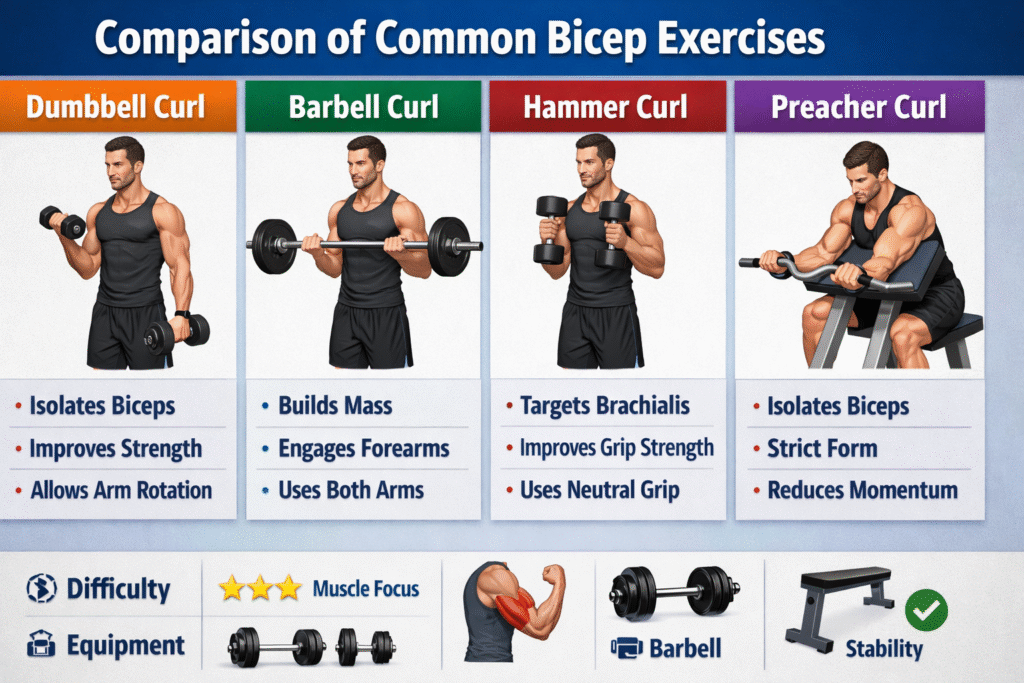
| Exercise | Equipment | Muscle Activation | Beginner Friendly |
|---|---|---|---|
| Dumbbell Curl | Dumbbells | High | Yes |
| Barbell Curl | Barbell | Very High | Moderate |
| Hammer Curl | Dumbbells | Moderate | Yes |
| Cable Curl | Machine | Consistent | Yes |
Benefits Vs Risks Comparison
| Benefits | Risks |
|---|---|
| Increased arm strength | Tendon strain |
| Improved muscle definition | Elbow discomfort |
| Better joint support | Overtraining fatigue |
| Enhanced athletic performance | Muscle imbalance |
Safe Usage Guidelines
Proper Warm-Up
Warming up improves blood flow and reduces injury risk during resistance training [14].
Controlled Repetitions
Using controlled movement improves muscle engagement and reduces joint stress [15].
Adequate Recovery
Allowing 48 hours between intense bicep sessions supports muscle repair and growth [16].
Who Should Avoid It
Individuals With Joint Disorders
People with chronic elbow or shoulder conditions should consult a healthcare professional before starting bicep workouts [17].
Post-Injury Recovery
Training should be modified or postponed following muscle or tendon injuries [18].
Alternatives
Bodyweight Training
Exercises like chin-ups and inverted rows activate the biceps without isolated loading [19].
Resistance Bands
Bands provide joint-friendly resistance suitable for beginners and rehabilitation [20].
Expert Opinions
Sports Science Perspective
Experts emphasize technique over heavy loads to reduce injury risk and improve long-term results [21].
Strength Coaches Recommendations
Certified trainers recommend combining compound and isolation exercises for balanced arm development [22].
Key Takeaways
- Bicep workouts improve strength, appearance, and functional performance
- Progressive overload is essential for growth
- Proper technique and recovery reduce injury risk
- Balanced training ensures sustainable results
FAQs
How Often Should Biceps Be Trained
Most research supports training biceps two to three times per week for optimal growth [23].
Are Heavy Weights Necessary
Moderate weights with proper form can be equally effective for hypertrophy [24].
Can Beginners Start Bicep Workouts
Yes, beginners benefit from low resistance and gradual progression [25].
Conclusion
Bicep workouts play a vital role in upper-body strength, aesthetics, and functional movement. When performed with proper technique, balanced programming, and evidence-based principles, they offer substantial benefits while minimizing risks. Understanding how bicep workouts work allows individuals to train smarter, achieve sustainable results, and maintain long-term joint health.
References
- American Council on Exercise, Muscle Anatomy Guide
- Schoenfeld BJ, Resistance Training Mechanisms, 2010
- Kraemer WJ et al., Progressive Overload Research, 2002
- National Strength and Conditioning Association Manual
- McGill S, Core and Upper Body Balance, 2014
- Schoenfeld BJ, Muscle Hypertrophy Review, 2016
- Escamilla RF, Elbow Joint Stability Study, 2012
- Phillips SM, Muscle and Metabolism Research, 2014
- Rees JD et al., Tendon Overuse Injuries, 2009
- Behm DG, Resistance Training Safety, 2005
- Kendall FP, Muscle Imbalance Effects, 2005
- ACSM Resistance Training Guidelines, 2018
- Schoenfeld BJ, Training Volume Study, 2017
- Fradkin AJ, Warm-Up Benefits Review, 2010
- Wilk KE, Controlled Movement Study, 2002
- Damas F, Muscle Recovery Research, 2016
- Mayo Clinic, Joint Health Guidelines
- British Journal of Sports Medicine, Injury Recovery, 2015
- Youdas JW, Bodyweight Exercise Activation, 2010
- Andersen LL, Resistance Band Training Study, 2010
- Journal of Strength and Conditioning Research, Technique Analysis, 2014
- NSCA Coaches Conference Proceedings
- Grgic J, Training Frequency Meta-Analysis, 2018
- Schoenfeld BJ, Load vs Hypertrophy Study, 2015
- Ratamess NA, Beginner Strength Adaptation, 2009