
Dr Ahsan Tariq , MBBS, MRCP (UK ) ongoing, IMT ( Internal Medicine Trainee, NHS England), GMC : 7805049
Dr Ahsan Tariq is a UK-registered medical doctor with a background in internal medicine and a focus on evidence-based research in cognitive health and nootropics. He critically reviews scientific studies, supplements, and ingredients to help readers make informed, safe, and effective choices for brain health and performance.
Introduction
Nootropics for Deep Meditation: In a world overloaded with information and stress, achieving a deep meditative state is increasingly challenging. For many, wandering thoughts, fatigue, or anxiety prevent true stillness. As neuroscience and mindfulness research evolve, nootropics substances that enhance cognitive and emotional performance are emerging as powerful tools for supporting deeper, more focused meditation.
While meditation trains the mind to observe, nootropics may enhance the brain’s biochemical readiness for stillness, helping practitioners enter states of calm awareness faster and sustain them longer. This article explores the connection between nootropics and meditation, the science behind their synergy, the most effective compounds, safety considerations, and practical stacking strategies.
Understanding Nootropics and Deep Meditation
What Are Nootropics?
The term nootropic was first coined by Dr. Corneliu Giurgea in 1972 to describe compounds that enhance mental functions like memory, creativity, and focus without causing harm. Nootropics can be natural (like herbs and amino acids) or synthetic (such as racetams).
For meditation, the most effective nootropics tend to be natural adaptogens and neurotrophic compounds they calm the nervous system, reduce mental noise, and increase clarity without overstimulation.
What Is Deep Meditation?
Deep meditation refers to an advanced state of profound mental stillness and awareness, often accompanied by slower brainwave frequencies (alpha, theta, and sometimes delta) [4]. Achieving this state regularly can take years of disciplined practice.
Nootropics may help bridge this gap by enhancing neural balance, focus, and stress resilience, enabling a smoother transition from everyday mental chatter to inner quietude.
The Science of Meditation and Brain Chemistry
Brainwaves and Neurotransmitters
During deep meditation, research shows increased alpha (8–12 Hz) and theta (4–8 Hz) wave activity, which are associated with calm alertness and introspection. These states correspond with elevated GABA, serotonin, and dopamine levels neurotransmitters that regulate relaxation, mood, and attention.
How Nootropics Influence Meditation States
Certain nootropics can mimic or enhance the brain’s natural meditative chemistry:
- L-Theanine promotes alpha waves.
- Ashwagandha reduces cortisol, the stress hormone.
- Bacopa Monnieri increases serotonin and GABA.
- Lion’s Mane promotes neural growth and plasticity.
By supporting neurotransmitter balance and neurogenesis, these substances help the brain enter and sustain meditative states more efficiently.
Top Nootropics for Deep Meditation
The following compounds have been scientifically linked to improved calmness, focus, and emotional regulation all essential for meditation.
| Nootropic | Primary Benefit | Mechanism of Action | Recommended Dosage |
| L-Theanine | Promotes relaxation without drowsiness | Boosts alpha waves and GABA | 100–200 mg/day |
| Lion’s Mane Mushroom | Enhances focus and brain growth | Stimulates Nerve Growth Factor (NGF) | 500–1000 mg/day |
| Bacopa Monnieri | Improves memory, reduces anxiety | Increases serotonin, antioxidant action | 300–450 mg/day |
| Ashwagandha | Reduces stress and cortisol | Balances hypothalamic-pituitary-adrenal axis | 300–600 mg/day |
| Rhodiola Rosea | Fights fatigue and burnout | Regulates cortisol, enhances ATP energy | 200–400 mg/day |
| Ginkgo Biloba | Improves attention and oxygen flow | Increases cerebral blood circulation | 120–240 mg/day |
| Magnesium L-Threonate | Calms the mind and supports plasticity | Boosts synaptic density and GABAergic tone | 1000–2000 mg/day |
Detailed Overview of Each Nootropic
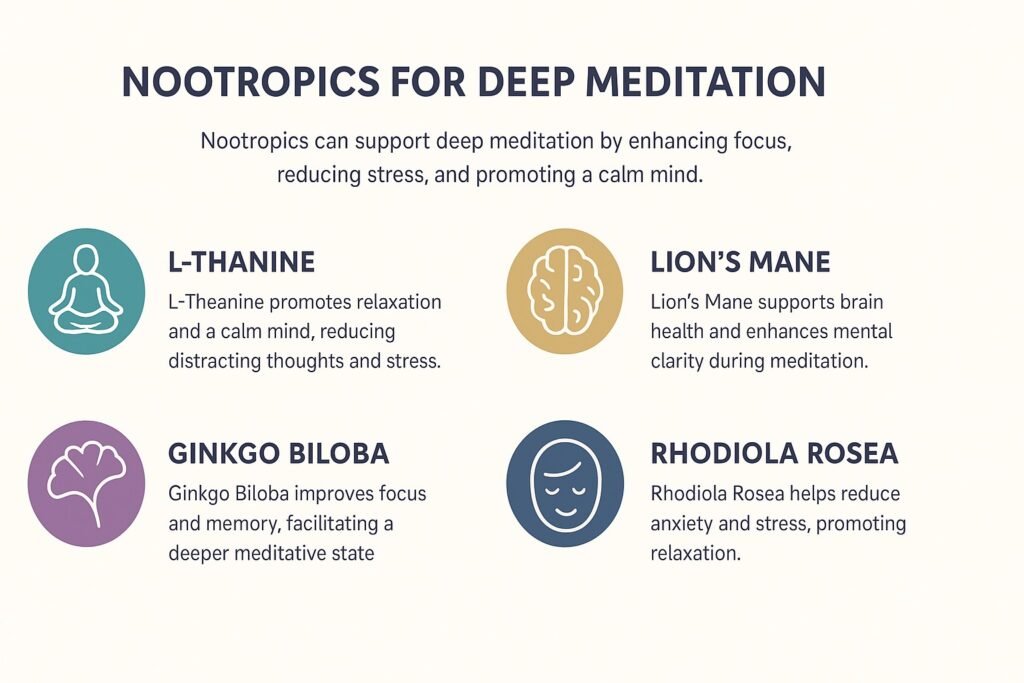
1. L-Theanine – The Gateway to Alpha Waves
Found in green tea, L-Theanine increases alpha wave activity, promoting relaxed alertness. It also modulates dopamine and GABA, reducing stress while maintaining focus.
- Best for: Evening or pre-session meditation.
- Stack Tip: Combine with low caffeine for enhanced mindfulness.
2. Lion’s Mane Mushroom The Neurogrowth Enhancer
Lion’s Mane (Hericium erinaceus) supports neuroplasticity and NGF synthesis, helping meditation practitioners enhance long-term focus and sensory awareness.
- Long-Term Benefit: Promotes neural regeneration and emotional balance.
3. Bacopa Monnieri The Tranquility Amplifier
An Ayurvedic herb with over 50 clinical studies, Bacopa Monnieri improves memory, attention, and stress resilience. It supports serotonin production, creating a calm and positive mindset ideal for meditative focus.
- Note: Effects build up over 4–6 weeks of use.
4. Ashwagandha The Stress Regulator
Ashwagandha (Withania somnifera) is an adaptogen proven to lower cortisol levels and anxiety. It enhances resilience to stressors, allowing a smoother transition into meditative depth.
- Bonus: Improves sleep and mood critical for consistent meditation.
5. Rhodiola Rosea The Energy Balancer
This adaptogen boosts mitochondrial energy efficiency and reduces fatigue. It helps prevent burnout from long meditation or breathwork sessions.
- Ideal For: Morning meditation and spiritual retreats.
6. Ginkgo Biloba The Clarity Catalyst
Ginkgo enhances blood flow to the brain, improving oxygenation and cognitive endurance [16]. For meditators, this means sharper awareness without overstimulation.
- Pair With: Bacopa for a synergistic effect on attention and calm.
7. Magnesium L-Threonate The Nervous System Soother
This bioavailable form of magnesium penetrates the blood-brain barrier and supports synaptic density. It helps stabilize overactive neurons, promoting sustained stillness during meditation.
- Take Before: Bedtime or evening meditation.
How Nootropics Complement Meditation
1. Enhancing Focus and Attention
Nootropics like Bacopa and Ginkgo strengthen working memory and attention span, preventing distraction during meditation.
This enables practitioners to hold awareness on the breath, mantra, or visualizations longer without mental drift.
2. Reducing Anxiety and Mental Noise
Adaptogens such as Ashwagandha and Rhodiola reduce sympathetic nervous system overactivity (the “fight or flight” response), allowing the parasympathetic system the “rest and digest” mode to dominate [19]. This switch is critical for achieving stillness.
3. Promoting Neuroplasticity and Emotional Clarity
Compounds like Lion’s Mane encourage neurogenesis, while Bacopa improves emotional regulation, making meditation not only more accessible but also more transformative.
Creating a Meditation Nootropic Stack
Combining nootropics can amplify effects when balanced properly. Below is a sample stack designed for deep meditation:
| Time | Stack Components | Purpose |
| Morning Meditation | L-Theanine (200 mg), Lion’s Mane (500 mg), Rhodiola (300 mg) | Calm alertness and focus |
| Evening Meditation | Ashwagandha (500 mg), Magnesium L-Threonate (1000 mg) | Deep relaxation and mental stillness |
| Long-Term Support | Bacopa (350 mg), Ginkgo (120 mg) | Cognitive balance and clarity |
Note: Always start with single compounds to observe tolerance and effects before stacking.
Practical Guidelines for Using Nootropics in Meditation
1. Timing Matters
Take nootropics 30–60 minutes before meditation, aligning with absorption rates.
Adaptogens like Ashwagandha can be taken daily, while stimulatory nootropics should be cycled.
2. Maintain Mindful Awareness
Nootropics enhance meditation when used with clear intention. Before consuming, set a mental affirmation e.g., “I use this to deepen awareness, not escape discomfort.”
3. Pair with Breathwork and Hydration
Deep breathing and adequate hydration improve oxygen flow and nutrient absorption, maximizing nootropic effects.
4. Journal and Reflect
Track your mood, focus, and depth of meditation. Over time, you’ll identify which compounds harmonize best with your unique neurochemistry.
Potential Risks and Side Effects
Even natural nootropics can cause side effects if misused:
- Overstimulation: High doses of Rhodiola or caffeine-containing stacks.
- Sedation: Excess L-Theanine or Ashwagandha.
- Gastrointestinal issues: Some herbal extracts may irritate the stomach.
- Tolerance: Continuous use without cycling may reduce effectiveness.
Safety Tip: Always consult a healthcare professional before beginning any supplement regimen, especially if taking prescription medication.
Long-Term Benefits: A Harmonized Mind
When used responsibly, nootropics can reinforce meditation’s neurological and psychological benefits, including:
- Enhanced neuroplasticity and brain longevity
- Decreased anxiety and depression markers
- Improved sleep and recovery
- Greater emotional intelligence and mindfulness
This combination of inner training (meditation) and biochemical support (nootropics) forms a modern synergy melding ancient wisdom with cutting-edge neuroscience.
Conclusion
Deep meditation isn’t about escaping the world. It’s about entering it more fully. Nootropics act as gentle facilitators, helping the mind sustain focus, regulate emotions, and nurture calm awareness.
From L-Theanine’s alpha wave magic to Lion’s Mane’s neural rejuvenation, each compound plays a role in balancing the mental environment where true mindfulness flourishes.
When combined with consistent practice, proper rest, and self-awareness, nootropics can be a powerful ally in your spiritual evolution, transforming meditation from effort into effortless presence.
References
Tang, Y. Y., et al. Nature Reviews Neuroscience, 2015.
Giurgea, C., Pharmacology of Nootropics, 1972.
Kennedy, D. O., Nutrients, 2016.
Cahn, B. R., & Polich, J., Psychological Bulletin, 2006.
Travis, F., & Wallace, R. K., Consciousness and Cognition, 1999.
Streeter, C. C., et al., Medical Hypotheses, 2010.
Nobre, A. C., et al., Biological Psychology, 2008.
Chandrasekhar, K., et al., Indian Journal of Psychological Medicine, 2012.
Calabrese, C., et al., Phytotherapy Research, 2008.
Mori, K., et al., Biomedical Research, 2009.


2 thoughts on “Top Best Nootropics for Deep Meditation in 2025”