
Dr Ahsan Tariq , MBBS, MRCP (UK ) ongoing, IMT ( Internal Medicine Trainee, NHS England), GMC : 7805049
Dr Ahsan Tariq is a UK-registered medical doctor with a background in internal medicine and a focus on evidence-based research in cognitive health and nootropics. He critically reviews scientific studies, supplements, and ingredients to help readers make informed, safe, and effective choices for brain health and performance.
Introduction:
Synthetic vs Natural Nootropics: In 2025 the conversation about cognitive enhancement is more mainstream than ever. Students, professionals, biohackers, and clinicians are asking the same question: Should I use synthetic nootropics or natural ones? Both promise improved focus, memory, or mental energy but they differ in mechanism, speed, risk, and long-term implications. This guide breaks down the science, compares real-world use cases, and gives practical, evidence-based advice so you can choose what fits your goals and safety profile.
(Throughout this article, I cite primary research, meta-analyses, clinical trials, and authoritative reviews; click any reference number to read the source.)
What is a Nootropic?
“Nootropic” historically described compounds that enhance learning and memory with low toxicity. Today it’s an umbrella term covering everything from prescription wakefulness drugs and racetams (synthetic) to herbal extracts and nutrients (natural). For clarity in this article:
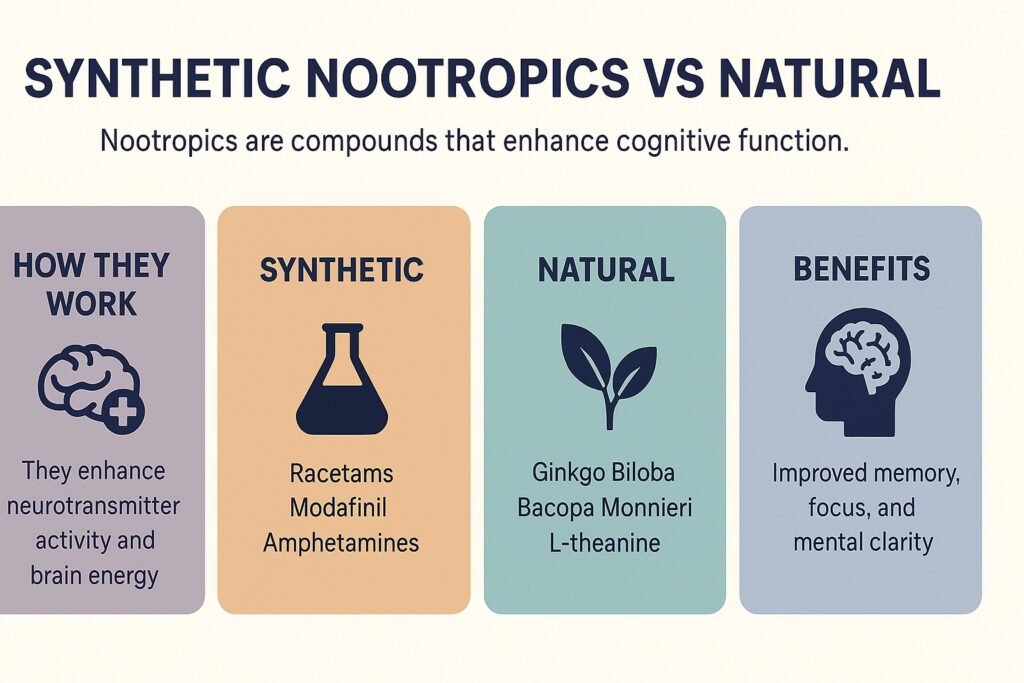
- Synthetic nootropics = lab-designed molecules (piracetam, modafinil, noopept, newer designer racetams and analogues).
- Natural nootropics = plant extracts, fungi, nutrients, and adaptogens (Bacopa, Ginkgo, Ashwagandha, Lion’s Mane, omega-3s).
Both categories have evidence and limitations the tradeoffs are the heart of the “synthetic vs natural” choice.
How they work mechanisms explained
Direct neurotransmitter modulation vs systemic support
Synthetic nootropics often act directly on neurotransmitter systems and synaptic receptors (for example, racetams modulate glutamatergic and cholinergic signaling; modafinil affects monoaminergic systems), producing rapid changes in attention and alertness. Natural nootropics tend to act more indirectly: improving blood flow, providing antioxidant/anti-inflammatory support, modulating stress physiology, or supplying precursors for neurotransmitter synthesis.
Neuroprotection & plasticity
Many natural agents also exert neuroprotective effects (scavenging free radicals, lowering neuroinflammation) and can support neuroplasticity over weeks or months. Some synthetic compounds are designed to promote plasticity at the receptor level, but long-term safety for healthy users remains less established.
Energy metabolism and circulation
Improved neuronal energy (mitochondrial function) or cerebral microcirculation are complementary mechanisms found across both classes but emphasized differently: synthetics often enhance metabolic efficiency quickly; naturals more commonly improve microvascular and metabolic resilience over time.
The evidence: synthetic nootropics
What the trials show
- Modafinil: multiple RCTs and reviews show modafinil improves attention, sustained vigilance, and some executive functions in healthy, non-sleep-deprived adults, with modest side effects reported.
- Racetams (piracetam, aniracetam, phenylpiracetam): older literature shows benefit in cognitive impairment and aging, while effects in healthy young adults are variable; mechanisms and outcomes differ across analogues.
- Noopept & newer analogues: promising preclinical and small clinical data show memory and neuroprotective signals, though large, long-term RCTs in healthy people are lacking.
Pros and cons (synthetic)
Pros: rapid onset, often stronger acute effects, precision of dose and pharmacology.
Cons: higher potential for insomnia, anxiety, tolerance or rebound; limited long-term safety data in healthy populations; legal/regulatory restrictions for some agents.
The evidence: natural nootropics
What the trials show
- Bacopa monnieri: the strongest single-herb RCT evidence for memory enhancement: multiple randomized, placebo-controlled trials and meta-analyses report improved memory recall and learning after consistent supplementation for 8–12 weeks.
- Ginkgo biloba: mixed evidence: small benefits shown in some elderly or impaired groups; healthy adult effects are modest and inconsistent.
- Rhodiola & Ashwagandha: adaptogens showing reductions in stress, mental fatigue, and improved subjective cognition in several trials.
- Lion’s Mane: early clinical data suggest potential cognitive benefits and support for mild cognitive impairment, but larger RCTs are ongoing.
- Omega-3 fatty acids, B vitamins, and choline: consistent evidence for supporting brain structure/function, particularly over long periods and in deficiency or aging contexts.
Pros and cons (natural)
Pros: generally safer with milder, slower-onset effects; additional systemic health benefits (antioxidant, anti-inflammatory, adaptogenic).
Cons: variability in product quality and potency; slower to act; some herb-drug interactions exist and some studies are small or heterogeneous.
Side effects, interactions & safety (both classes)
Common adverse effects
- Synthetic: insomnia, irritability, headaches, increased heart rate, potential appetite suppression; risk of tolerance or dependence for certain classes. Rare psychiatric adverse events exist for vulnerable people.
- Natural: GI upset, allergic reactions, or herb-drug interactions (e.g., Ginkgo with anticoagulants; St. John’s wort with many meds). Quality-control problems (contaminants, mislabeled extracts) are a real risk with supplements.
Who should avoid or be cautious
Pregnant or breastfeeding people, children and adolescents (especially synthetics), people with uncontrolled cardiovascular disease, certain psychiatric diagnoses, epilepsy, and those on interacting medications should consult clinicians before use.
Comparison table: Quick at-a-glance
| Criterion | Synthetic Nootropics | Natural Nootropics |
| Onset of effect | Fast (hours to days) | Slow (weeks) |
| Typical potency | High | Moderate |
| Side effect risk | Higher (sleep, mood, cardiovascular) | Lower (GI, interactions) |
| Long-term evidence in healthy users | Limited | Growing, but variable |
| Quality control | Often pharmaceutical grade (if prescription) | Variable; pick certified brands |
| Best use case | Acute performance, clinical targets | Long-term brain health, stress resilience |
Practical guidance: how to choose and use
Match goals with risk tolerance
- For short, high-stakes needs (all-nighters, concentrated project phases) an evidence-backed synthetic (e.g., prescription modafinil under supervision) can be effective but understand side effects and legal/regulatory implications.
- For sustained cognitive health and gentle enhancement, natural agents like Bacopa, Rhodiola, and omega-3s are preferable and safer for long-term use.
Stack carefully (and test singles first)
If stacking, test single ingredients individually for 2–3 weeks before combining. Keep dose logs, note subjective and objective performance (timed tasks, focus scores), and cycle (e.g., 5 days on, 2 days off, or 8 weeks on / 2 weeks off) to reduce tolerance.
Quality control matters
Choose products that provide standardized extracts, third-party certificates of analysis (COA), and transparent sourcing. For synthetics, use legitimate, regulated channels and avoid unverified “research chemicals”.
Real-world stacks and examples
- Beginner, natural first: Omega-3 + Bacopa (standardized extract) + good multivitamin; combine with sleep and exercise.
- Professional needing acute lift (short term): Short cycle of modafinil under medical supervision + choline precursor to reduce headaches.
- Balanced hybrid: Low-dose racetam + Bacopa + adaptogen (Rhodiola) but only after single-ingredient trials and medical check.
The Missing Pieces: Research gaps & the 2025 Frontier
- Long-term RCTs in healthy populations are still rare for many synthetics; safety data beyond a year are sparse.
- Standardization of herbal trials: differences in extract preparation, dosage, and endpoints hamper meta-analysis progress being made with standardized extracts like Bacopa CDRI-08.
- Personalized nootropics: 2024–25 research is beginning to pair genomic, metabolomic, and behavioral phenotyping with individualized stacks (AI-driven prescriptions are emerging) promising but early.
- Hybrid molecules & delivery tech: biotech is exploring compounds that combine synthetic precision with natural scaffolds, and nano-delivery systems to cross the blood–brain barrier more effectively and safely.
Lifestyle: the baseline nootropic you can’t skip
Whatever you choose, evidence shows that sleep, nutrition, exercise, social connection, and mental challenge are the most reliable long-term “nootropics.” Supplements & drugs are adjuncts not replacements. Prioritize the fundamentals, then layer targeted interventions.
Practical checklist before you start any nootropic
- Discuss with a healthcare professional if you take medication or have health conditions.
- Start with lifestyle optimization (sleep, diet, exercise).
- Choose a single, well-researched ingredient and test it for several weeks.
- Use third-party tested products.
- Track effects objectively and subjectively.
- Cycle use to reduce tolerance.
- Stop if adverse effects appear; seek medical advice.
Conclusion: Which side “wins”?
There is no universal winner. Synthetic nootropics can provide powerful, fast cognitive boosts but come with higher risks and uncertain long-term data. Natural nootropics are generally safer for long-term brain health, with supportive evidence for certain botanicals (notably Bacopa), adaptogens, and nutrients. The wisest, evidence-based approach in 2025 is informed personalization: optimize lifestyle first, favor well-studied natural agents for sustainable benefit, and consider short, supervised synthetic use only when the reward justifies the risk.
References
- American Nootropic Association. “Synthetic vs Natural Nootropics Overview.”
- Mayo Clinic. “Cognitive Enhancers: Benefits and Risks.”
- Harvard Health Publishing. “Natural Nootropics for Brain Health.”
- National Institute of Mental Health. “Smart Drugs and Cognitive Function.”
- Anxiety and Depression Association of America. “Nootropics and Mental Focus.”
- Mental Health America. “Natural vs Synthetic Supplements for Cognition.”
- National Center for Complementary and Integrative Health. “Herbal Nootropics and Brain Health.”
- Psychology Today. “The Pros and Cons of Synthetic Nootropics.”
- Cleveland Clinic. “Brain-Boosting Supplements: Safety and Effectiveness.”
- Mayo Clinic Proceedings. “Cognitive Enhancement: Natural and Synthetic Approaches.”



One thought on “Synthetic vs Natural Nootropics”